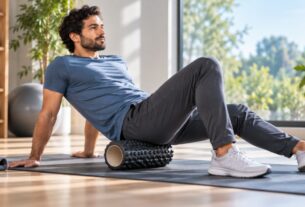

If you regularly experience muscle tightness, soreness, or stiffness, you may have come across two popular recovery tools: foam rollers and myofascial release balls. Both can help loosen tight muscles, improve mobility, and support recovery, but they work in slightly different ways.
So, which one should you choose?
The answer depends on your goals, the areas of your body you want to target, and how much pressure you prefer. In this guide, we’ll compare a foam roller vs. a myofascial release ball to help you decide which recovery tool is right for you.
What Is Myofascial Release?
Before comparing the two tools, it helps to understand what myofascial release means.
Fascia is a connective tissue that surrounds and supports your muscles, bones, and other structures. When muscles are overused, stressed, or kept in the same position for long periods, the surrounding tissues can feel tight or restricted.
Myofascial release is a technique that uses sustained pressure to help reduce the sensation of tightness and improve movement. Foam rollers and myofascial release balls are commonly used as self-massage tools to apply this pressure.
What Is a Foam Roller?
A foam roller is a cylindrical recovery tool made from foam or similar materials. You use your body weight to roll over the roller, applying pressure to larger muscle groups.
Foam rollers are particularly useful for areas such as:
- Quadriceps
- Hamstrings
- Calves
- Glutes
- Upper back
- Lats
Because of their larger surface area, foam rollers can cover significant portions of a muscle at once.
Benefits of Using a Foam Roller
1. Covers large muscle groups
One of the biggest advantages of a foam roller is its ability to work on large areas efficiently. For example, rolling your quadriceps can address much of the muscle group in a single session.
2. Useful for warm-ups and recovery
Many people use foam rolling before exercise as part of a mobility routine and after workouts to help relieve the feeling of muscle tightness.
3. Easy to incorporate into a routine
Foam rolling can be relatively straightforward once you learn the correct positions. It can be a useful addition to a home workout or recovery routine.
4. Different pressure options
Foam rollers come in different densities and textures. A softer roller may be more comfortable for beginners, while a firmer or textured roller can provide a more intense sensation.
What Is a Myofascial Release Ball?
A myofascial release ball is a small, firm ball designed to provide targeted pressure to specific areas of the body.
Unlike a foam roller, which distributes pressure across a larger surface, a release ball concentrates pressure on a smaller point.
Common areas for using a myofascial release ball include:
- Feet
- Glutes
- Shoulders
- Upper back
- Hips
- Calves
- Chest muscles
Release balls are particularly useful when you want to focus on a specific area that is difficult to reach with a foam roller.
Benefits of Using a Myofascial Release Ball
1. Targeted pressure
The smaller surface area allows you to apply pressure to a specific spot. This can be helpful when you have a particularly tight or sensitive area.
2. Great for hard-to-reach areas
A release ball can often reach areas that are difficult to work with a cylindrical foam roller, including the soles of the feet and certain parts of the shoulders and glutes.
3. Portable
Most release balls are small and lightweight, making them convenient to carry to the gym, office, or while traveling.
4. More control over pressure
You can adjust the amount of pressure by changing your body position or how much weight you place on the ball.
Foam Roller vs. Myofascial Release Ball: Key Differences
While both tools can be useful for muscle recovery and mobility, they have different strengths.
| Feature | Foam Roller | Myofascial Release Ball |
| Surface area | Large | Small |
| Pressure | Broad and distributed | Focused and targeted |
| Best for | Large muscle groups | Specific tight areas |
| Portability | Moderate | Excellent |
| Learning curve | Generally easy | Easy, but requires precise positioning |
| Common uses | Legs, back, glutes | Feet, shoulders, hips, glutes |
| Pressure control | Body position and roller density | Body position and weight distribution |
Which Is Better for Muscle Recovery?
Neither tool is universally better. Your choice depends on what you are trying to accomplish.
If you want to work on large muscle groups after a workout, a foam roller may be the better option. It allows you to cover areas such as your quads, hamstrings, and calves efficiently.
If you have one specific area that feels tight, a myofascial release ball may be more appropriate. Its smaller surface allows you to focus pressure on a particular location.
For many people, using both tools together can provide a more versatile recovery routine.
For example, you might use a foam roller on your thighs and calves before using a release ball on your feet or glutes.
Foam Roller vs. Release Ball for Different Activities
For Runners
Runners often place significant demands on their calves, quads, hamstrings, and glutes. A foam roller can be useful for covering these larger muscle groups.
A release ball can complement this routine by targeting the feet or specific tight spots around the hips and glutes.
For Weightlifters
Strength training can leave certain muscle groups feeling tight after a workout. A foam roller can be useful for broad areas such as the quads and upper back.
A release ball can provide more targeted pressure around areas such as the glutes and shoulders.
For Desk Workers
Long periods of sitting can contribute to feelings of stiffness, particularly around the upper back, shoulders, hips, and glutes.
A release ball can be convenient for targeted self-massage, while a foam roller can be useful as part of a broader mobility routine.
Which Tool Should Beginners Choose?
If you’re new to self-myofascial release, a foam roller may be the easier starting point because it provides broader and generally more predictable pressure.
Start with a softer or medium-density roller and spend a short amount of time on each muscle group. Avoid immediately applying excessive pressure.
Once you’re comfortable with foam rolling, you can add a myofascial release ball to target smaller or harder-to-reach areas.
Can You Use Both a Foam Roller and a Myofascial Release Ball?
Yes. In fact, combining the two can make your recovery routine more versatile.
A simple routine could look like this:
- Start with gentle movement or a warm-up.
- Use a foam roller on larger muscle groups.
- Use a release ball on specific areas that need more focused attention.
- Follow with mobility exercises or stretching.
- Drink water and allow your body to recover.
The goal isn’t to apply as much pressure as possible. Instead, use a level of pressure that feels manageable and allows you to relax the surrounding muscles.
Safety Tips for Myofascial Release
Self-massage tools are generally easy to use, but more pressure isn’t necessarily better.
Keep these tips in mind:
- Start with gentle pressure, especially if you’re new to foam rolling.
- Avoid rolling directly over bones and joints.
- Don’t apply intense pressure to areas with acute pain, swelling, bruising, or injury.
- Stop if you experience sharp, shooting, numb, or unusual pain.
- Avoid spending excessive time on one sensitive area.
- If you have an injury or medical condition, ask a qualified healthcare professional whether self-myofascial release is appropriate for you.
Final Verdict: Foam Roller or Myofascial Release Ball?
So, foam roller vs. myofascial release ball, which is right for you?
A foam roller is the better choice if you want to work on larger muscle groups, improve mobility, and make recovery part of your regular fitness routine.
A myofascial release ball is ideal if you want targeted pressure, greater portability, and access to smaller or harder-to-reach areas.
However, you don’t necessarily have to choose just one. Using a foam roller for broad muscle work and a release ball for targeted areas can give you the flexibility to address different recovery needs.
Ultimately, the best tool is the one that fits your body, goals, comfort level, and routine. Start gradually, focus on controlled pressure, and use these tools as part of a broader approach to mobility and recovery.
FAQ’s
Is a foam roller better than a massage ball?
Not necessarily. Foam rollers are better suited to larger muscle groups, while massage balls provide more targeted pressure. Many people benefit from using both.
Can a myofascial release ball replace a foam roller?
A release ball can complement a foam roller, but it may not be as efficient for working across large muscle groups such as the quads or hamstrings.
How often should you use a foam roller or release ball?
There isn’t one ideal frequency for everyone. They can be incorporated into a regular mobility or recovery routine as long as the pressure remains comfortable and doesn’t cause excessive soreness.
Should foam rolling hurt?
Foam rolling may feel uncomfortable when working on tight areas, but it shouldn’t cause sharp or severe pain. If something hurts significantly, reduce the pressure or stop.
Can I use these tools before exercise?
Yes. Gentle self-myofascial release can be incorporated into a warm-up or mobility routine before exercise. Keep the session relatively brief and follow it with dynamic movement.
RELATED POST: NetSuite Release Management