
Participating in a major trade fair is an opportunity for businesses to introduce innovations, meet potential customers, and establish valuable industry connections.
However, achieving these objectives requires more than reserving exhibition space and displaying products. Companies searching for the best exhibition stand builders in Germany should consider how effectively a contractor combines creative design, practical construction, technical planning, and event coordination. Stand Builders GmbH, a Berlin-based exhibition stand design and construction company, provides integrated solutions that help exhibitors prepare professional exhibition environments across Germany and Europe.
Why Exhibition Success Depends on More Than an Attractive Booth?
Trade fairs bring together businesses competing for the attention of visitors who often have limited time. Although visual appeal influences first impressions, the actual effectiveness of an exhibition stand depends on how well it supports communication and interaction.
A successful stand should help visitors understand what a company offers, identify relevant products, and connect with representatives without unnecessary confusion. This requires a thoughtful combination of branding, spatial organisation, accessibility, and presentation technology.
For example, a healthcare company may need dedicated areas for explaining technical products, while an industrial manufacturer might require sufficient space for equipment demonstrations. A business introducing digital services could benefit from interactive displays and comfortable consultation areas.
These requirements demonstrate why professional exhibition planning should focus on the visitor experience as much as architectural appearance.
Turning Exhibition Objectives into Practical Design Decisions
Before selecting materials or developing visual concepts, exhibitors should determine what they want to accomplish during the event.
Some businesses participate primarily to introduce new products, while others focus on lead generation, distributor relationships, or strengthening their market presence. Each objective influences how the available exhibition space should be organised.
Creating a Clear Visitor Journey
An effective exhibition layout guides visitors naturally from the entrance toward relevant displays and interaction areas.
Open entrances can encourage exploration, while strategically positioned information counters make it easier for visitors to request assistance. Product displays should remain visible without restricting movement.
For larger stands, separate demonstration and meeting areas can help visitors navigate different activities comfortably.
Making Brand Communication More Effective
Exhibition graphics should communicate essential information quickly. Complicated messages, excessive text, and inconsistent branding can make even an impressive structure difficult to understand.
Clear signage, appropriate lighting, coordinated colours, and well-positioned digital displays can improve communication.
The most useful design elements are those that help visitors recognise the brand and understand its products or services.
Choosing the Right Exhibition Stand Structure
Not every exhibition requires the same type of stand. The most appropriate solution depends on the event’s purpose, available floor space, budget, and expected visitor activities.
Stand Builders GmbH provides four main exhibition stand solutions that address different exhibiting requirements.
Custom Exhibition Stands
Custom stands are developed around specific brand identities and presentation objectives. They offer flexibility in layout, architectural features, product displays, and interactive elements.
This approach is suitable for companies requiring distinctive exhibition environments or specialised demonstration facilities.
Modular Exhibition Stands
Modular stands consist of adaptable components that can be configured for different exhibition spaces.
Businesses attending several trade fairs may benefit from their flexibility and potential for reuse. Modular construction can also simplify certain transportation and assembly requirements.
Double-Decker Exhibition Stands
Double-decker stands introduce an additional level, allowing exhibitors to separate public-facing activities from meeting or hospitality areas.
They can be useful for larger exhibitions where businesses need additional functional space within their allocated footprint.
However, these structures require suitable engineering, venue permissions, and compliance with applicable safety requirements.
Country Pavilion Exhibition Stands
Country pavilions provide coordinated exhibition environments for multiple organisations representing a country, region, or trade association.
Their design must balance a shared visual identity with individual presentation areas, allowing participating businesses to communicate their offerings while maintaining a unified appearance.
Why Düsseldorf Requires Careful Exhibition Planning?
Düsseldorf is an important German exhibition destination, hosting international events across healthcare, manufacturing, packaging, marine industries, and other commercial sectors.
Major exhibitions such as MEDICA, COMPAMED, and boot Düsseldorf attract businesses with different presentation needs. Consequently, exhibition planning in the city requires an understanding of both industry expectations and venue-specific requirements.
Companies working with an exhibition stand design company in Düsseldorf can coordinate their stand concepts with practical construction and installation considerations.
Stand Builders GmbH provides design, manufacturing, delivery, and project management support for exhibitions in Düsseldorf. Its services include custom layouts, modular structures, double-decker stands, and country pavilion solutions.
For exhibitors, early coordination is particularly valuable when projects involve specialised lighting, product demonstrations, large equipment, or complex stand structures.
Adapting Booth Layouts to Different Industries
A medical technology exhibition may require clean presentation areas, clear product information, and private meeting facilities. In contrast, an industrial event might prioritise equipment accessibility, technical displays, and demonstrations.
Exhibitors should also consider the expected audience. A stand designed for procurement professionals may require detailed product information and consultation areas, while a consumer-oriented presentation might place greater emphasis on open displays and interactive experiences.
Understanding these differences allows businesses to allocate their exhibition space more effectively.
The Value of Coordinated Design and Construction
Exhibition projects involve multiple stages that must be completed within strict deadlines. Design development, material selection, manufacturing, transportation, installation, and dismantling all influence the outcome.
When these activities are poorly coordinated, exhibitors may experience delays, unexpected adjustments, or unnecessary expenses.
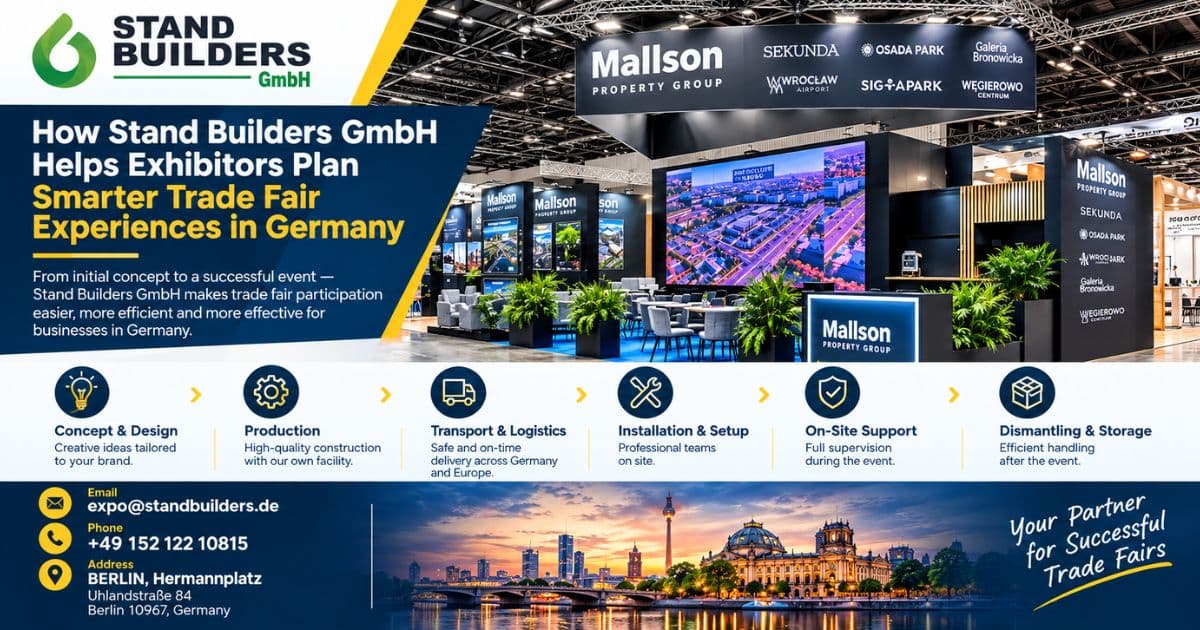
Stand Builders GmbH follows an integrated project process that includes initial briefing, three-dimensional design, production, packaging, delivery, installation, and post-event dismantling.
The company also provides in-house production capabilities and on-site project management, helping connect design development with construction requirements.
Reviewing the Stand Before Production
Three-dimensional design concepts allow exhibitors to evaluate the proposed structure before manufacturing begins.
This stage provides an opportunity to review branding positions, product placement, visitor circulation, meeting areas, and overall presentation.
Identifying necessary adjustments early can reduce the risk of costly modifications during installation.
Managing Technical and Logistical Requirements
Trade fair venues commonly establish requirements for construction heights, electrical installations, structural safety, delivery access, and installation schedules.
Exhibitors should confirm these conditions before finalising their stand design.
Professional coordination helps ensure that production plans, transportation arrangements, and installation activities reflect the relevant venue regulations and deadlines.
Building More Sustainable Exhibition Strategies
Sustainability is becoming an increasingly relevant consideration in exhibition planning. Temporary structures can require substantial quantities of materials, transportation resources, and packaging.
Businesses can reduce unnecessary waste by considering reusable components, adaptable graphics, durable materials, and efficient logistics.
Modular structures are particularly relevant for organisations attending several events because certain components can be reconfigured rather than replaced.
Custom exhibition stands can also incorporate reusable features when future exhibition requirements are considered during the design stage.
Nevertheless, environmental performance depends on the complete project, including materials, transport distances, manufacturing methods, and the number of times components are reused.
A practical sustainability strategy should therefore evaluate the entire exhibition lifecycle rather than focusing only on individual materials.
Evaluating Exhibition Performance After the Event
The effectiveness of an exhibition stand should be assessed against the objectives established before the trade fair.
Visitor numbers provide useful information, but they do not necessarily indicate commercial success. A business may benefit more from a smaller number of qualified conversations than from substantial traffic with limited relevance.
Useful performance indicators include:
- Qualified business leads and potential sales opportunities.
- Product demonstrations and meaningful visitor interactions.
- Meetings with existing customers and prospective partners.
- Follow-up appointments and commercial discussions.
- Visitor feedback on stand accessibility and presentation.
Exhibitors should also review operational factors such as installation efficiency, storage requirements, and the suitability of the stand layout.
These findings can inform improvements for future exhibitions and help businesses make more effective decisions about stand investment.
Conclusion
A productive trade fair appearance requires a combination of clear objectives, thoughtful design, reliable construction, and effective project coordination. Exhibition stands should not simply attract attention; they should create practical environments that encourage communication, product exploration, and valuable business relationships.
Stand Builders GmbH supports these requirements through its custom, modular, double-decker, and country pavilion solutions, alongside integrated design, manufacturing, logistics, and installation services. Its work across German exhibition destinations, including Düsseldorf, reflects the importance of adapting stand concepts to different industries and event requirements.
For businesses planning future trade fair participation, the most valuable approach is to treat exhibition stand development as a strategic investment. When design decisions align with audience expectations and commercial objectives, the exhibition space becomes a meaningful part of the company’s wider marketing strategy.
RELATED POST: The Evolution of Tamil Cinema in the Digital Entertainment Era