
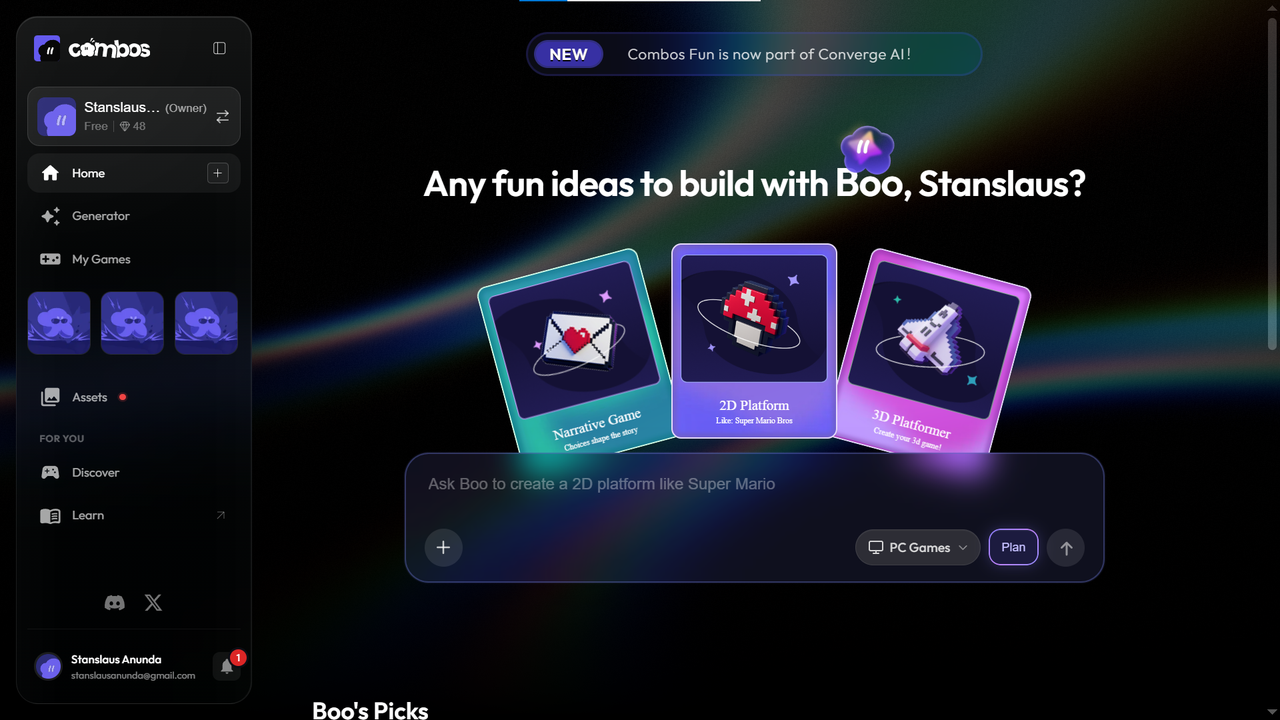
A game design document, or GDD, is the blueprint that connects an idea to a build. It provides some of the mechanics, learning and engagement goals, content organisation, and scope before a single asset is created. You’ll end up building blind and halfway through realizing your mechanic doesn’t meet your goal, or that the scope is twice as long as you can realistically handle in your time.
The issue is that a handwritten FDD is a skill, and for non-developers, one of the reasons they avoid pursuing a game idea. The ai game builder tackles this by creating a GDD for you based on a prompt and thereby reduces the requirement for design experience to a review and edit process.
What Does an AI-Generated GDD Actually Contain?
Boo, the AI game agent, outputs a well-defined document outlining the core mechanics, target audience, content flow, and how the pieces come together for Combos after you describe your concept. Not a hodgepodge description; this is specific enough that you can detect issues early before they’re too late and too costly, such as a mechanic that does not match your stated audience, or a content structure that’s too ambitious for the time that you have.
This step matters just as much whether you’re building a flat 2D experience or something more visually ambitious with a 3d game maker online; the underlying design logic needs to be right before the platform starts generating 3D assets around it.
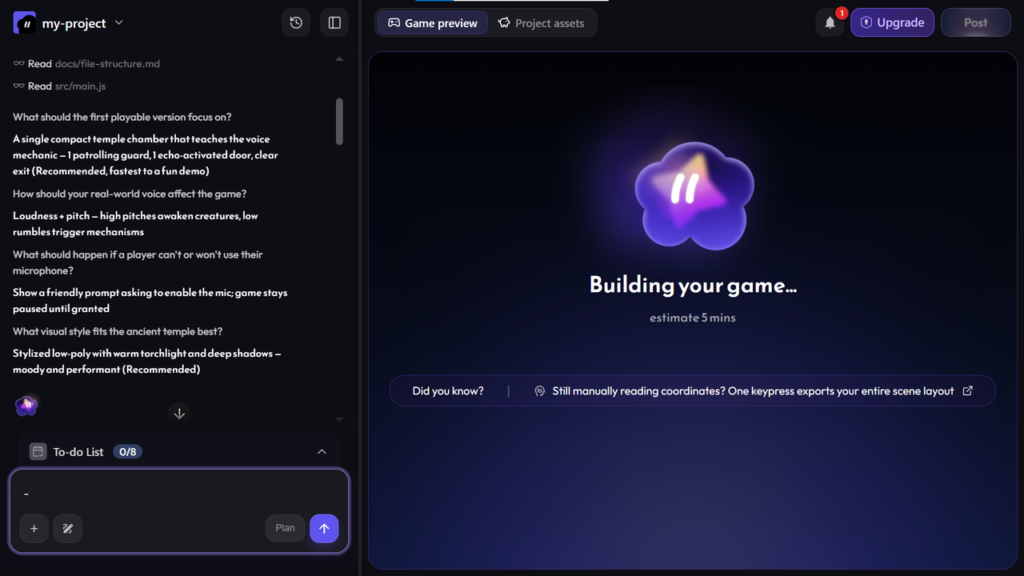
Why Reviewing the GDD Is the Most Important Step?
It’s easy to jump from the design document to the generated assets, the fun part anyway. However, the one chance you have to get the project back on course is the GDD. With a bad design, if the assets are created, then changes to the underlying structure are a redo job. If the same issue is identified at the GDD stage, the paragraph will be edited.
Consider the GDD as a contract with the system; read it in full, review and confirm that all the listed objectives are ones you intend to carry out, and note any that do not match your own before continuing. If you don’t know for sure if a proposed mechanic achieves your goal, then our overview of game design principles can help you.
Common Issues to Catch Early
- Scope creep: the generated document proposes more content than you have time to review and refine
- Mismatched audience: mechanics pitched at a different skill or age level than your actual players
- Vague objectives: a learning or engagement goal stated too broadly to actually shape the mechanics around it
- Missing constraints: platform requirements, time limits, or branding needs you forgot to mention in your prompt
These are all caught up at the document stage, and feedback takes a sentence. They can only be caught after generation, which requires a rebuild.
From Document to Build
Once the GDD reflects what you actually want, Combos moves into asset generation and no-code editing based on that approved structure. Carefully considering the design document is crucial to the quality of everything downstream of this.
How Detailed Should Your Initial Prompt Be?
You don’t want to hand the system less than what it needs to do, nor do you want to do all the work yourself, since that is why you’re generating the document in the first place. If you can, make sure you are explicit about the things that matter most to your outcome, audience, tone, core mechanic, and any hard constraints such as time limit or platform requirements, and leave the structural details to Boo to fill in; the things you’re not so sure about. There is always time to tighten it up if it’s too loose in the review stage!
Another thing to consider is the first prompt, which is not a spec, but rather a draft brief. A GDD can be generated in mere moments, and so there is little to no cost of regenerating a GDD if it doesn’t arrive as you want the first time you try to describe the concept. Don’t treat the first version as a one-shot job you have to get right; use it as a conversation starter with the system.
Comparing GDDs Across Iterations
If you’re creating a series of similar games, e.g., multiple review games in the same course or a handful of branded mini-games in the same campaign, then it is a good idea to have all your approved GDDs available for comparison. Reading through a sequence of documents as they change from one to another helps you identify trends of what your readers are going to like and dislike, and makes your next prompt much faster to write since you know what works and what doesn’t.
The Real Value of an AI-Generated GDD
It’s not only about speed but also about value. It’s that design thinking, which was once a skill that could only be learned by training or experience, that can be learned by anyone who can articulate an idea and evaluate the results critically. It’s a “reasonably low threshold” to understand learning design theory from scratch, and this is why no-code game platforms quietly make one of the most valuable parts of their offerings: AI-generated GDDs.
RELATED POST: AI Game Design Documents: What They Are and Why They Matter?